
If you’ve ever downloaded free software, explored open-source projects, or worked with WordPress themes, you’ve likely encountered the term “GPL” — the GNU General Public License. Despite its widespread use, GPL remains one of the most misunderstood licenses in software development.
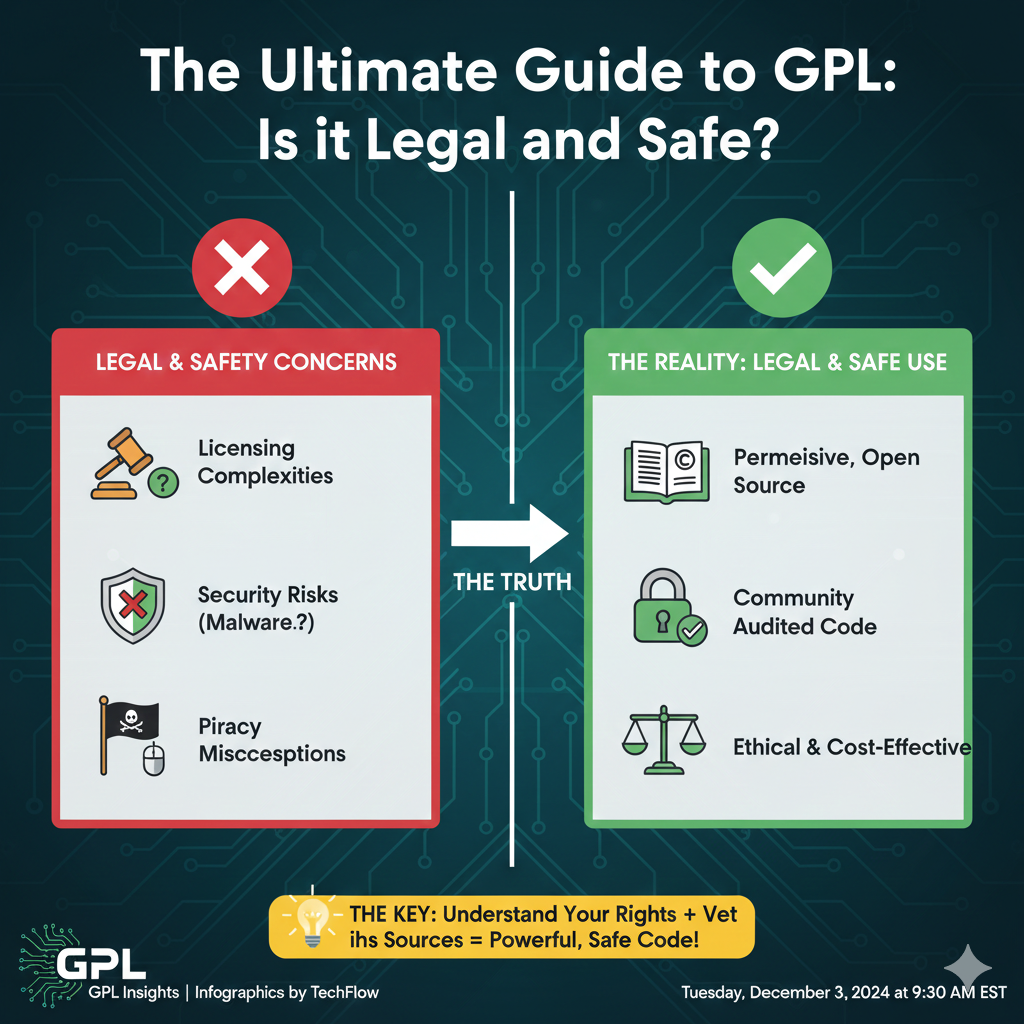
This guide answers the burning questions: Is GPL legal? Is it safe to use GPL software? And what do you actually need to know before using, modifying, or distributing GPL-licensed code?
What is GPL?
The GNU General Public License (GPL) is a free software license created by Richard Stallman and the Free Software Foundation in 1989. It’s designed to guarantee end users the freedom to run, study, share, and modify software.
Unlike proprietary licenses that restrict what you can do with software, GPL is a “copyleft” license — meaning it ensures software remains free and open by requiring any modifications or derivative works to also be distributed under the same GPL terms.
There are three main versions in use today:
- GPL v2 — Released in 1991, still widely used (notably by Linux kernel)
- GPL v3 — Released in 2007, addresses patent rights and digital restrictions
- LGPL (Lesser GPL) — Allows linking with proprietary software, common for libraries
Is GPL Legal? Absolutely
Here’s the straightforward answer: Yes, GPL is completely legal. It’s a legally binding software license that has been tested and upheld in courts worldwide.
Legal Foundation
GPL is built on copyright law. When someone creates software, they automatically own the copyright. The GPL license is simply the copyright holder’s way of granting specific permissions to users while maintaining certain conditions.
Think of it like renting a house — the landlord (copyright holder) permits you to live there (use the software) under specific terms (the GPL conditions). As long as you follow the terms, everything is perfectly legal.
Court-Tested Validity
GPL has been enforced successfully in multiple legal cases:
- Jacobsen v. Katzer (2008) — U.S. Court of Appeals confirmed open-source licenses are legally enforceable
- GPL violations in Germany — Multiple successful enforcement actions by gpl-violations.org
- Artifex Software v. Hancom (2017) — U.S. court awarded damages for GPL violation
These cases established that GPL terms are binding contracts, and violating them can result in copyright infringement claims.
Is GPL Safe to Use?
Safety in software comes down to two concerns: legal safety and technical security. GPL scores well on both fronts.
Legal Safety
Using GPL software is legally safe when you comply with the license terms. The key requirements are:
For personal use: You can use GPL software freely with zero obligations. Install it, modify it, run it — no restrictions apply until you distribute it.
For distribution: If you share or sell GPL software (including modifications), you must:
- Provide the source code or make it available
- Include the GPL license text
- Clearly state any modifications you made
- License your derivative work under GPL as well
For business use: Companies can use GPL software internally without any distribution obligations. The license only kicks in when software leaves your organization.
Technical Security
GPL software isn’t inherently more or less secure than proprietary alternatives. Security depends on code quality, not license type.
However, GPL does offer transparency advantages:
- Source code is publicly reviewable for vulnerabilities
- Security researchers can audit and patch issues
- Community scrutiny often leads to faster bug fixes
- No hidden backdoors or malicious code (it would be discovered)
Many security-critical systems run on GPL software — Linux powers most web servers, Android phones, and cloud infrastructure. If it weren’t safe, the internet as we know it wouldn’t exist.
Common Misconceptions About GPL
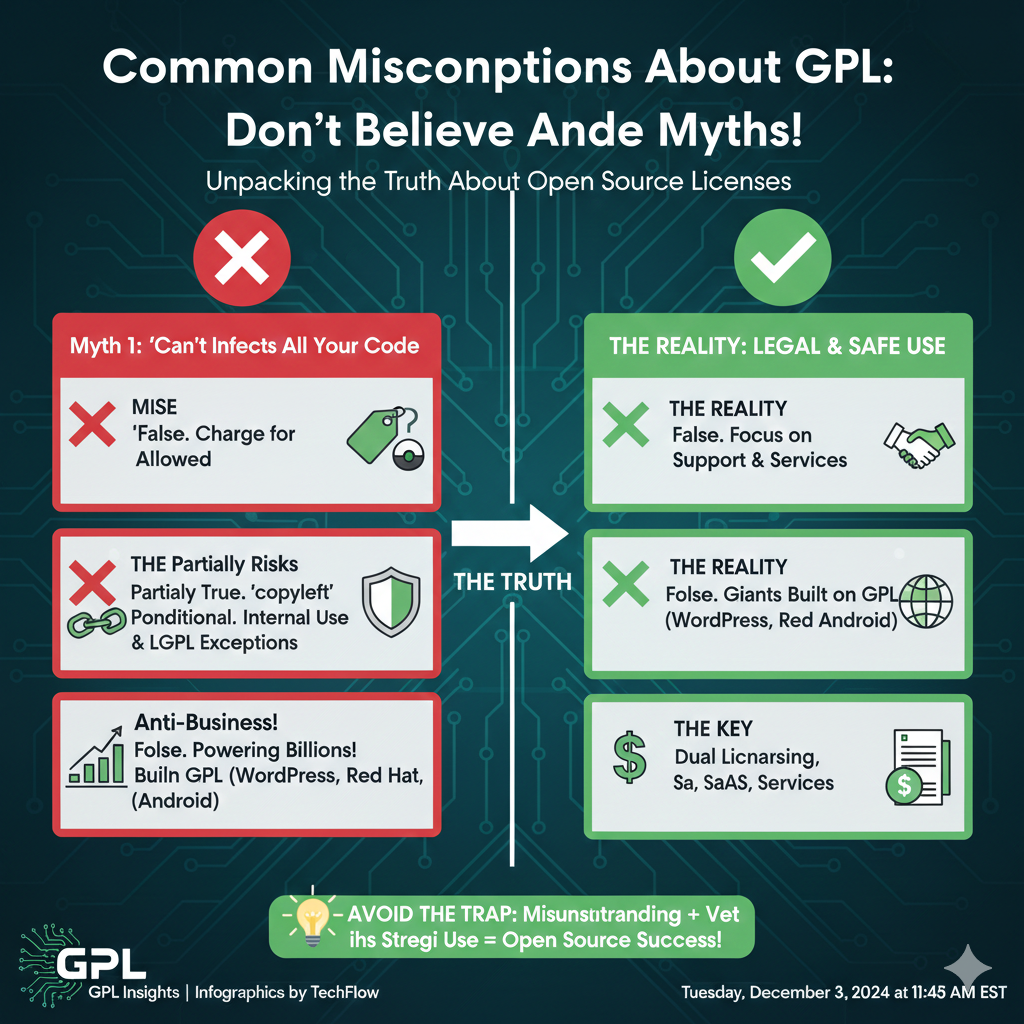
Myth 1: “GPL Means You Can’t Charge for Software”
False. GPL explicitly allows selling software. You can charge whatever you want for GPL programs. The catch? You must also provide source code to buyers, and they have the right to redistribute it (potentially for free).
This is why GPL business models often focus on support, services, and enterprise features rather than simple software sales.
Myth 2: “Using GPL Code Infects All Your Code”
Partially true. This is called the “copyleft” effect. If you incorporate GPL code into your project and distribute it, your entire project must be GPL-licensed. However:
- Internal use doesn’t trigger this requirement
- LGPL libraries can be linked without infection
- API calls to GPL software don’t necessarily cause infection
- The infection applies to derivative works, not to separate programs
Myth 3: “GPL Is Anti-Business”
False. Thousands of successful businesses build on GPL software:
- Red Hat was acquired for $34 billion (GPL-based Linux distribution)
- WordPress powers 43% of all websites (GPL-licensed)
- MySQL became a billion-dollar company (dual-licensed including GPL)
- Android uses the GPL Linux kernel (powers 70%+ of smartphones)
GPL can be business-friendly when you understand how to work with it.
Myth 4: “You Can’t Use GPL in Commercial Products”
False. You absolutely can. The restriction isn’t on commercial use — it’s on keeping modifications proprietary. You can sell GPL software commercially, but you must provide source code to your customers.
Many companies navigate this through:
- Dual licensing (offering both GPL and commercial licenses)
- Building proprietary services around GPL core
- Selling support and enterprise features
- Hosting GPL software as a service (SaaS loophole)
GPL in the Real World
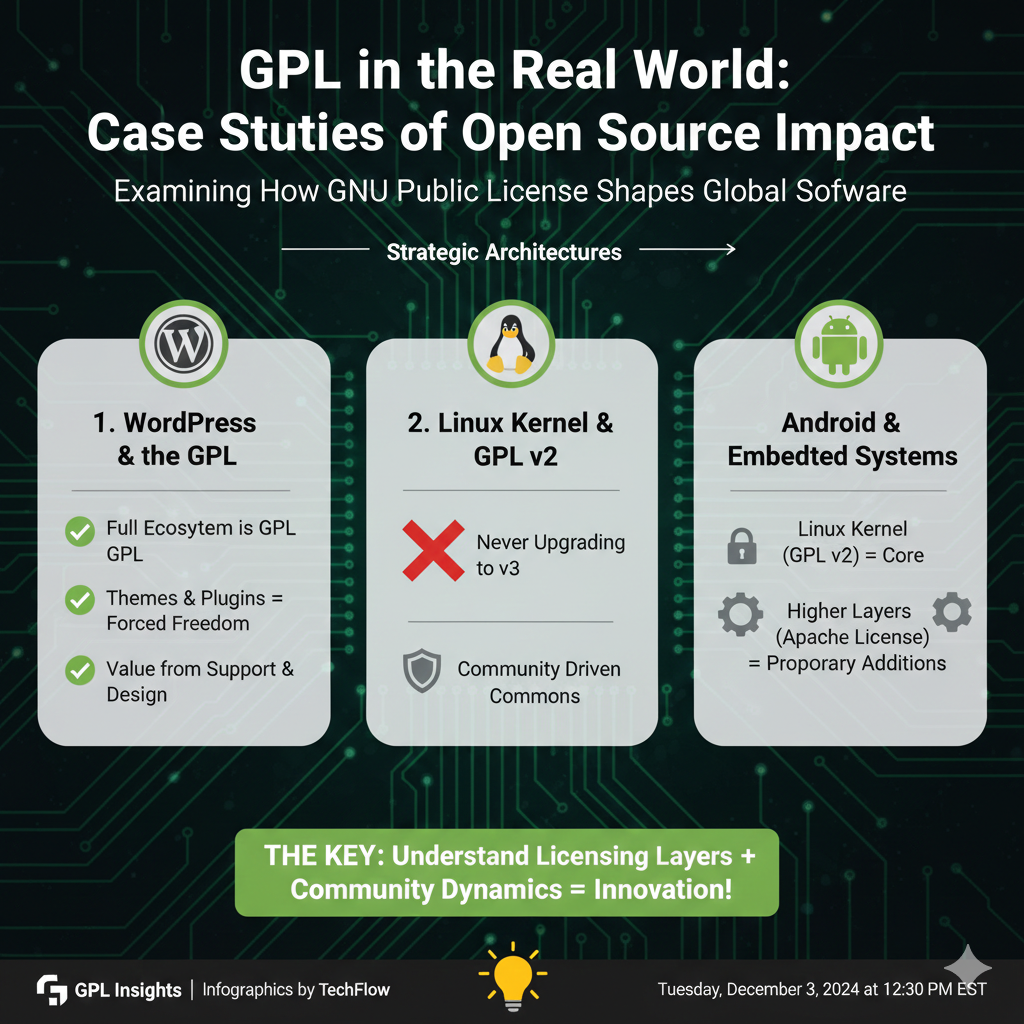
WordPress and GPL
WordPress is perhaps the most successful GPL project in history. The entire WordPress ecosystem — core software, themes, and plugins — is GPL-licensed. This means:
- Anyone can download, modify, and sell WordPress
- Premium themes must be GPL (though artwork may have separate licenses)
- You can’t restrict what users do with WordPress code you sell them
This “forced freedom” creates an interesting dynamic where value comes from updates, support, and design rather than code scarcity.
Linux Kernel and GPL v2
The Linux kernel uses GPL v2 and explicitly will never upgrade to v3. Linus Torvalds chose v2 because it better matches his vision of software freedom. This demonstrates that even within GPL, there are philosophical differences about how freedom should be implemented.
Thousands of companies contribute to Linux because GPL ensures their contributions benefit everyone, creating a commons that prevents any single company from monopolizing the code.
GPL in Mobile and Embedded Systems
Android uses the Linux kernel (GPL v2) for its core, but Google carefully architected Android to keep higher-level components under Apache license. This allows manufacturers to add proprietary modifications without releasing source code — a deliberate design to encourage commercial adoption.
This shows how companies strategically use GPL in certain layers while avoiding it in others.
How to Comply With GPL
If you’re using or distributing GPL software, follow these best practices:
For Users
- Download and use GPL software freely
- No obligations unless you distribute
- Modify for personal use without restrictions
For Developers Distributing GPL Code
- Include the license — Always include the full GPL license text
- Provide source code — Either bundle it or offer written commitment to provide it
- Document modifications — Clearly indicate changes you’ve made
- Use the same license — Derivative works must also be GPL
- Credit original authors — Maintain copyright notices
For Businesses
- Audit your codebase — Identify all GPL dependencies before launching a new project or business. If you’re building SaaS tools or apps, it helps to validate your approach early, similar to how entrepreneurs might check name uniqueness before committing to a brand
- Consult legal counsel — Get professional advice for complex scenarios
- Consider dual licensing — Offer both GPL and commercial licenses
- Document everything — Keep records of compliance efforts
- Establish processes — Create company policies for GPL usage
Alternatives to GPL
If GPL’s copyleft requirements don’t fit your needs, consider these alternatives:
Permissive Licenses
- MIT License — Minimal restrictions, allows proprietary use
- Apache 2.0 — Similar to MIT but with explicit patent grants
- BSD Licenses — Very permissive, multiple variants
These allow incorporating code into proprietary products without requiring source release.
Other Copyleft Licenses
- LGPL — Copyleft for libraries, allows proprietary linking
- AGPL — Stronger copyleft that covers network use (SaaS)
- Mozilla Public License — File-level copyleft (middle ground)
Dual Licensing
Some projects offer both GPL and commercial licenses, letting users choose based on their needs. This works well for libraries and development tools.
The Philosophy Behind GPL
Understanding GPL requires understanding its creator’s intent. Richard Stallman designed GPL not just as a legal tool, but as a social movement for software freedom.
The four essential freedoms GPL guarantees:
- Freedom to run the program for any purpose
- Freedom to study how the program works and adapt it
- Freedom to redistribute copies
- Freedom to improve and share improvements
GPL sees software as knowledge that should be shared, not hoarded. It’s not anti-commercial, but it is anti-monopoly. The license ensures no single entity can close off the commons that GPL creates.
Whether you agree with this philosophy or not, understanding it helps you work effectively with GPL software.
Should You Use GPL?
The answer depends on your goals:
Choose GPL if you:
- Want to ensure your code stays open source
- Believe in software freedom philosophy
- Want to prevent proprietary forks of your work
- Are building community-driven projects
- Don’t mind others profiting from your code if they share improvements
Avoid GPL if you:
- Plan to keep modifications proprietary
- Need to combine code with proprietary systems
- Want maximum commercial flexibility
- Prefer a permissive licensing philosophy
- Are you building closed-source products
There’s no universal “right” choice — it depends on your values, business model, and technical requirements.
Conclusion
GPL is both legal and safe when you understand and follow its terms. It’s one of the most successful software licenses in history, powering everything from personal computers to global infrastructure.
The license isn’t about restricting freedom — it’s about preserving it. By requiring that modified versions remain open, GPL creates a growing commons of free software that benefits everyone.
Whether you’re a hobbyist downloading WordPress, a developer contributing to open source, or a business building products, GPL offers a clear framework. The key is understanding the obligations and making informed choices about when GPL aligns with your goals.
Used correctly, GPL software can be the foundation for everything from personal projects to billion-dollar businesses. The question isn’t whether GPL is legal or safe — it demonstrably is. The real question is whether its philosophy of shared freedom matches what you’re trying to build.